The firemouth cichlid comes from Central America and loves to live in slow-moving rivers, canals, or ponds. Learn more about the habitat of the firemouth cichlid below.
When it comes to popular ornamental freshwater fish, the firemouth cichlid is surely on the list. The firemouth cichlid, also known as Thorichthys meeki, will color your tank thanks to its vivid, unique coloration. This small buddy is also perfect for aquarium beginners as they are very easy to keep. If you are curious about the habitat of the firemouth cichlid, keep reading.
Origins
This tropical fish, part of the family Cichlidae, was first discovered by Walter Brind in 1918. These species occur in Central America. They inhabit hyper-saline springs in the upper part of the Yucatán Peninsula, Mexico, El Salvador, Guatemala, Panama, Honduras, Nicaragua, and Costa Rica.
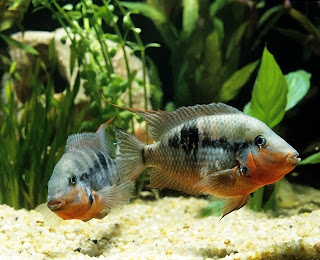
In the wild, the habitat of the firemouth cichlid lives in the water with 7,5pH or above. The firemouth cichlid’s name was taken from Seth Eugene Meek, an American ichthyologist or someone who learns about fish. The name meeki was chosen to honor Meek.
Thorichthys meeki prefer warm water and slow-moving rivers, canals, or ponds in their natural habitat. In addition, they stay in muddy and sandy bottoms. This fascinating creature is very adaptive. Therefore, they love to stay close to vegetation near the waterside. They eat algae and other meaty substances.
Moreover, the habitat of the firemouth cichlid can also be found on underwater cave systems. Here, the firemouth cichlid will be saved from larger fish or marine life. This species is not classified as a schooling animal, although they may live with other cichlid or fish.
Temperament
Because of the ornamental fish market, firemouth cichlid can be found in over seven countries. Their new habitats are found in the Africa, USA, Asia, and Australia. Most of the species were found to show signs of aggression. You can tell that they’re aggressive when they flare their blazing red throat.
However, if they are satisfied with the habitat and aren’t provoked, this fish is pretty peaceful. That is why housing this fish with other species is possible. Some of their favorite tank mates are cory catfish, swordtails, platies, kuhli loach, rummy nose tetra, bristlenose pleco, clown pleco, and rainbow fish.
Description
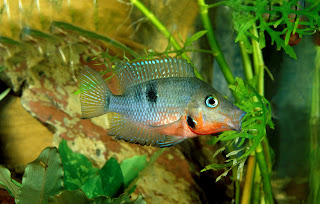
Now that you know the habitat of the firemouth cichlid, you probably haven’t been familiar with this fascinating species’ feature. This fish is popular with its vivid yellow-olive color in its body and head. On their ventral surface, these species have red or orange pigment. Along their flanks, there are black vertical stripes. There is vivid red color on the edge of their fins.
Normally, male firemouth cichlid can grow to twelve centimeters, while a female one grows to eight centimeters. Meanwhile, the standard length of firemouth cichlid in natural habitat is normally only four to six centimeters.
After learning the habitat of the firemouth cichlid in the wild, you sure want to add these species into your tank community. This fish is a great choice for beginners because they are pretty cheap and easy to care for.