
Getting to know Pangasianodon hypophthalmus

Pangasianodon hypophthalmus is a fish commodity that has been known for a long time in Indonesia. Fish belonging to this catfish class on the market consist of two popular types of fish, namely Pangasius djambal fish and Pangasianodon hypophthalmus fish.

The Pangasius djambal fish is a native fish from Indonesia, namely from the big rivers in Sumatra and Kalimantan, while the Pangasianodon hypophthalmus fish is a fish imported from Thailand.
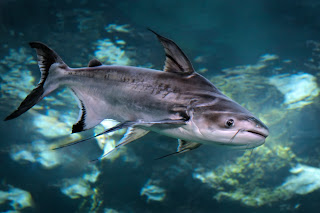

The largest fish production centers in Indonesia are in Sumatra and Kalimantan. In this area this fish can be easily found in rivers and lakes.

Classification of Fish Pangasianodon hypophthalmus:

Kingdom: Animalia
Phylum: Chordata
Class: Actinopterygii
Order: Siluriformes
Family: Pangasiidae
Genus: Pangasianodon
Species: P. hypophthalmus

Pangasianodon hypophthalmus fish has a white body like silver with a dark back but not scaly. The body length of this fish can reach 120 cm. Fish Pangasianodon hypophthalmus has a relatively small head with a mouth located at the tip of the head slightly below. This fish also has two pairs of whiskers located at the corners of its mouth, its function is as a touch tool.

On the back there is a soft fin that is very small in size and the tail fin forms a fork with a symmetrical shape. The anal fin is rather long and has 30-33 soft rays, the pelvic fin has 6 soft rays.

Pangasianodon hypophthalmus fish began to be spawned in Indonesia in 1980 and in 1990 this fish culture began to develop rapidly in West Java, Lampung, southern Sumatra and Kalimantan.

One of the triggers for the booming business of cultivating Pangasianodon hypophthalmus fish is the high selling price of Pangasianodon hypophthalmus fish, especially the size of consumption. The high selling price is because this fish has advantages in terms of taste and nutritional content compared to other types of catfish. The protein content of Pangasianodon hypophthalmus fish reached 68.7% with a fat content of 5.8%.

Another advantage compared to other types of freshwater fish is that Pangasianodon hypophthalmus has a relatively faster growth rate and this fish can live in locations that have low oxygen levels.

Popular posts from this blog

How to Choose a Good Quality of Koi Fish

Sometimes, purchasing koi fish to place in your pond can be difficult, especially when you haven’t decided which best type to take home. Well, if you ask, there are two aspects to be considered for choosing the best quality of koi fish. First, the price is the factor you need to think before making a decision. If you are a beginner, it is possible for you to make mistakes. So, it is better to choose the low-priced koi so you won't waste anything in a great deal. Second, the resilience of the koi is another thing you need to consider. As a beginner, you should anticipate the possible mistakes you will do in the future. Let's say that you may forget to feed them or clean their pond. That is why taking home koi with good resilience is a good idea. Then, after you understand those two aspects, you can read and think over the types of koi fish of good quality below. 1. Kohaku Koi Fish The impression of Kohaku Koi fish is simply iconic. Also, because of their resilience and their f...

Types of Cory Catfish and Fish Feed

(Meta description:  Cory catfish are loved for their friendly, sociable manners. They are also easily maintained. Get to know the type and how to  feed cory catfish.) Cory catfish is a favourite to those who love pet fish. They are friendly and easily maintained. Get to know the type of and how to feed cory catfish. 5 Types of Cory Catsifh                1.      Bronze cory catfish (Corydoras aeneus). This type of cory catfish can be either bronze (obviously) or green. They can grow as long as two and a half to three inches (7.5 centimetres). Another thing that affects their growth is the size of the aquarium. The bigger it is, the longer their bodies can grow.        2.      Panda cory catfish (Corydoras panda). With pale bodies, panda cory catfish have black patches on, especially around their eyes. Panda cory catfish is also often mistaken for Corydoras m...

Benefits of Maintaining Bala Sharks Fish at Home

Meta-Description: Here are some benefits of maintaining Bala Sharks fish at home. Know more to reveal what you can get from these stunning creatures. One of the exotic freshwater aquarium choices for the fish hobbyist is Bala Shark. The fish, also known as Tricolor Minow, are schooling fish that will give a magnificent addition to the tanks. And don't feel intimidated with the name, because, the only one that can relate this fish to that giant sea creature is the fin. Far from being dangerous and terrible, Bala Shark is an exotic fish with tolerant behavior and easy temperament. And there are still many benefits you can get from maintaining the fish in the tanks. Read more to know the benefits of maintaining Bala Sharks fish at home: Easy Feeding Habits Bala Shark is omnivores that naturally eat insects their own larvae and eggs, and phytoplankton. In the tanks, you can give them frozen food or dry ones. Their feeding habits are easy and won't burden you. Ho...